
Femigist: The Hormonal Skincare Brand Treating What Doctors Keep Missing

Rana Good is the founder of Naïra NYC. A writer for publications such as Forbes, Travel + Leisure, Coveteur, Mens Journal and others, she created her own platform celebrating women of color.
Women’s health has historically been both understudied and underfunded, and few conditions showcase this more than Polycystic Ovary Syndrome (PCOS). Affecting 11 to 13 percent of women globally, PCOS has faced a lack of standardized treatment and diagnostic delays. Femigist founder Amara Onwukaeme lived that gap firsthand, spending years in and out of doctor’s offices without answers before a ruptured ovarian cyst finally gave her a diagnosis. She responded by building what the medical system wouldn’t give her: Femigist, a seven-figure hormonal skincare and wellness brand that treats facial hair, cystic acne, and hyperpigmentation at the source, with Black women centered from the start.
Find out what Femigist does differently, and why that approach makes it more effective for everyone.
How did your personal story lead you to creating Femigist?
Amara Onwukaeme: Femigist is really a culmination of years of living with undiagnosed PCOS. In high school, I didn’t know it as PCOS, I just knew it as acne. In college, it showed up as cramps so debilitating I’d miss class and work. And in my adult years, it became facial hair that made me self-conscious every time I looked in the mirror.
Whenever I went to the doctor, I’d get the runaround. The OB-GYN would say, “We don’t do skincare.” The dermatologist would say, “We don’t do hormones.” I was constantly being redirected, and in between I was wandering the beauty aisles trying to treat everything on the surface because that’s where it was showing up. Nothing ever felt like a real solution; just prescriptions with side effects, expensive treatments that burned my skin, and a lot of dead ends.
That continued until one day I woke up in excruciating pain. It was getting worse with every step I took. My then-boyfriend had to help me walk to the car, and we went to the emergency room because I genuinely feared the worst. After seven hours, they ran tests — I’d even wondered if I was one of those people who didn’t know they were pregnant — but what they found was a ruptured ovarian cyst. The cysts were as large as grapes. And for the first time, a doctor said, “have you heard of PCOS?”
I had. I’d brought it up before. But it had always been brushed aside. In that moment, I finally had a name for everything I’d been experiencing, and with it, some validation. But even then, when I went back to my OB-GYN with that diagnosis, she gave me the exact same prescription as before. Same protocol, no new direction.
That’s when I knew I had to take this into my own hands. That rupture made the weight of this mission undeniable.
Walk me through some of your hero products and their purpose.
The hero products grew directly out of my own experience particularly with facial hair and acne. Facial hair was the thing that really got under my skin. I was constantly wondering if people were noticing it. It caused dark marks, ingrown hairs, and a lot of insecurity. And when I sought help, the options were frustrating: spironolactone from the doctor, a topical cream from the dermatologist, or laser hair removal which, as a woman of color, was both irritating to my skin and incredibly expensive for minimal results.
I kept thinking: I’m going to three different places for the same problem. So why not bring it all together?
That’s how the Chin Kit came to be; the first-ever three-step system designed around the full experience of dealing with hormonal facial hair. I chose to lead with systems rather than isolated products because there’s an entire experience to address when you’re dealing with a hormonal condition. And beauty is the entry point. Women aren’t standing at the mirror thinking, “My androgens are elevated.” They’re looking at the thing that’s bothering them. So I meet them there — with immediate physical relief — and then work deeper to address the specific hormone driving it.
That specificity is really central to what I do. “Hormonal balance” as a concept speaks to everyone and no one at the same time, it’s more of a slogan than a solution. Different hormones cause different things, so I focus on exactly which hormone is driving a specific condition and what you can realistically expect when it’s addressed.
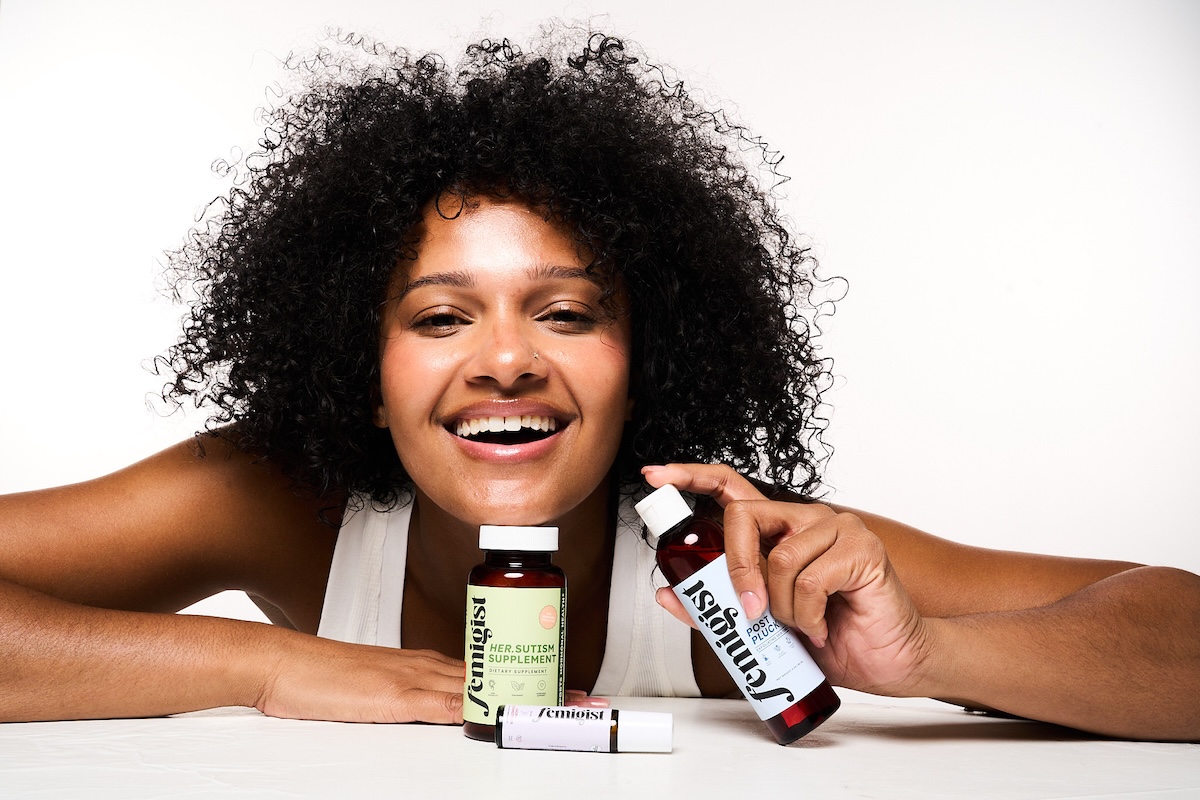
Our Hirsutism supplement is a perfect example: it’s a blend of ten ingredients, including three that specifically target the hormonal pathways responsible for facial hair. And it’s paired with our post-pluck toner, because for women of color, the experience doesn’t end with the hair. We deal with ingrown hairs at higher rates because of our curl pattern, and with hyperpigmentation and dark marks more intensely than non-pigmented skin. Everything is formulated with that in mind.
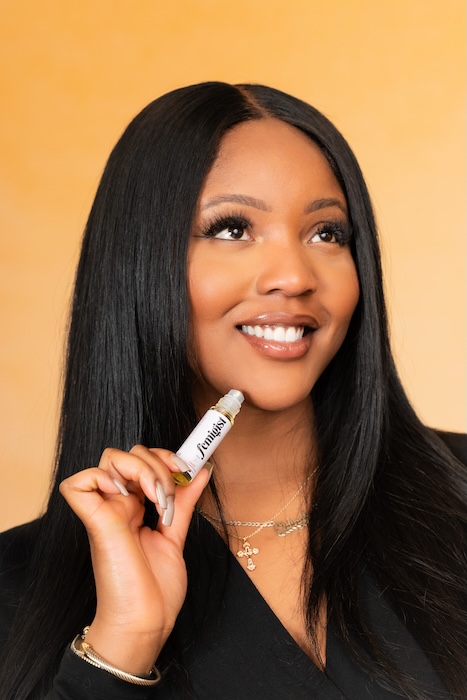
I also created Hairy Godmother, an oil designed as a laser hair removal alternative, because that treatment was genuinely damaging my skin. It works by shrinking the hair follicle the way laser does, without the irritation.
My thesis is this: when I formulate for women of color, who are often the most vulnerable and underserved customers, I end up creating a more effective product for everyone.
Femigist centers women of color. Can you tell me more about that?
Women of color are so profoundly underserved; in healthcare, in beauty, and in the hormonal wellness space. When we go to the doctor, we face higher rates of not being believed. Many treatments aren’t formulated with our skin tone in mind. And certain hormones, like testosterone, affect us at higher rates than our counterparts.
All of that is factored into how I formulate. My products are developed by a Black-owned lab, by women of color. We’re intentional about the concentration of acids so nothing is unnecessarily irritating. We think carefully about how each product will interact with deeper skin tones and specific hair textures. These aren’t afterthoughts, they’re the starting point.
Femigist is for everyone. But I genuinely believe that when you create something that works for Black women, you’ve created something that works for everybody.
Your title is Chief Estrogen Officer. What do you want to embody with that?
It’s cheeky, it’s playful and that’s very intentional. I wanted a way to make hormones feel approachable, because the way they’ve traditionally been discussed is often cold, clinical, and frankly alienating. Especially when you’re not a doctor.
And honestly, not being a doctor is my superpower. It roots me in the lived experience. I remember sitting in exam rooms thinking, “You’re a woman. don’t you get it? I’m telling you I can’t go to class because of my cramps.” And instead of feeling met, I left feeling worse than when I came in.
So I wanted to create something that signals: this is a space where you’re welcome, where this is talked about openly, where you don’t have to feel like you’re making too big a deal of something. Women of color especially have a long history of feeling dismissed or uncomfortable in medical and wellness spaces. If the Chief Estrogen Officer title makes someone smile and feel like they can actually engage with this topic, that’s exactly the point.
@xoxofemigist Our HERsutism supplement is the BEST product on the market to reduce female facial hair. It addresses hormones which is one of the most effective ways to address hirsutism. Get yours today! #hirsutism #femalefacialhair #hirsurtismwax #pcoswax #spearminttea #pcosproblems ♬ original sound – Cartiiier Chery
What are some things people don’t know about PCOS?
The biggest thing is that PCOS looks completely different from woman to woman. It doesn’t show up the same way twice. And that’s actually part of why so many women go undiagnosed for years, I certainly did.
There’s also some really significant news on this front. The condition was just recently renamed. It’s now called PMOS — Polyendocrine Metabolic Ovarian Syndrome. That shift is huge. Previously, the benchmark for a PCOS diagnosis was the presence of ovarian cysts. But what researchers have recognized is that this is really a broader endocrine condition; one that can affect your skin, your mood, your metabolism, your sleep, and so much more.
That reclassification is validating for so many women who had all the symptoms but were told, “Well, you don’t technically have cysts, so we can’t diagnose you.” I was one of those women. I had PCOS long before my ovarian cyst ruptured. It wasn’t until I was sitting in the emergency room that anyone officially said the words.
The old standard was too narrow. This shift acknowledges a much more complete picture and it means more women will finally be taken seriously before they reach a crisis point. That’s a huge win.
What have been some of your biggest milestones?
It’s been a wild ride — one I’m still grateful and honestly a little amazed to be on.
One of the earliest and most significant milestones was hitting seven figures within two years, entirely organically on TikTok. And this was pre-TikTok Shop — people were watching my videos, connecting with what I was saying, and going directly to the link in my bio to place orders. No paid ads, no retail. Just the content resonating.
From there, I was selected for Black Ambition Prize, Pharrell Williams’ initiative, as part of their second cohort. Having Pharrell as a mentor was an incredible experience — genuinely useful, not just a title.
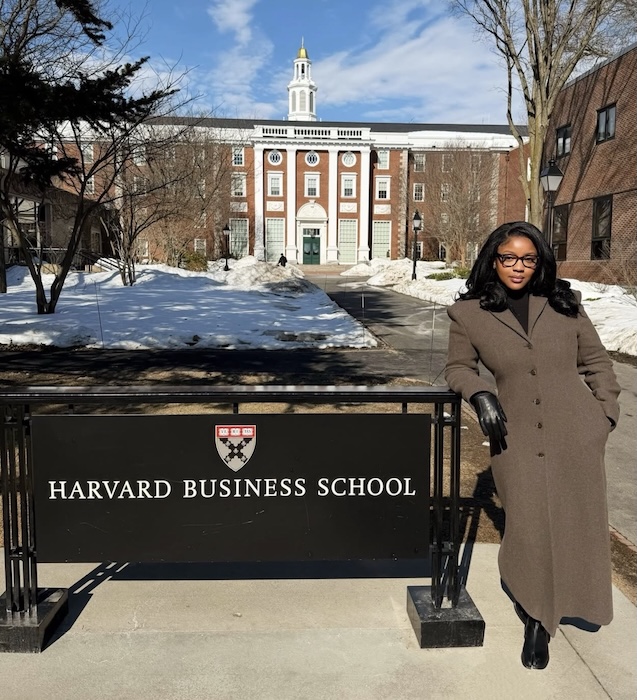
I’ve also received grants from Fiverr and Silicon Valley Bank, and I’ve pitched at business schools including Harvard, Wharton, and Yale — and won the pitch competitions at all three.
The milestone I’m probably most proud of is our partnership with Ulta Beauty. I was selected for their Muse accelerator program, which came with a $50,000 investment and placement in their retail pipeline. Ulta is making a real push into women’s wellness, and they chose Femigist as one of the brands they see as a pioneer in that space. We’re currently being considered for full retail placement, which we’re aiming for by the end of the year.
On the community side, we’re approaching a quarter million followers on TikTok and have served over 40,000 customers. All of that, almost entirely without an Instagram presence, which still kind of blows my mind.
What’s next for Femigist?
We’re doubling down on our inside-outside approach and expanding our systems.
The next big launch is SkinSync — a complete system for hormonal acne. It’ll include a supplement and something I’m really excited about: a jaw mask. Hormonal acne almost always shows up along the jawline, so we designed a mask that physically sits on the jaw and folds behind the ears. It’s formulated to calm redness and treat the cystic breakouts that are so specific to hormonal fluctuations.
We’re hoping to release SkinSync by the end of the year, and ideally it’ll be part of our Ulta launch. Fingers crossed.
Beyond that, we’re also in the middle of a rebrand and finally building out our Instagram presence. Femigist was born on TikTok, and we’ve accomplished a lot there — but it’s time to grow the ecosystem.